Best Time to Visit Sakleshpur: Month-by-Month Weather, Rain and What Each Season Is Good For
The best time to visit Sakleshpur depends on whether you want clear skies, full waterfalls or a quiet weekend. That is why one guide says October to March, another says the monsoon, and a third says September to May. Each is right, for a different kind of trip.
Sakleshpur is a hill town in the Malnad region of the Western Ghats, about 4 to 5 hours by car from Bengaluru, and its weather changes sharply across the year. One question keeps coming up, asked in a YouTube comment: "July me jana safe rhega?" (Will July be safe?).
This guide answers that, and goes through the year month by month so you can pick the month that fits your plans. Start with the short answer.
What is the best time to visit Sakleshpur
For most travellers, the best time to visit Sakleshpur is October to February, when days are about 26 to 30°C and nights cool to about 15 to 19°C. July to September suits those who want mist and full waterfalls, and can live with heavy rain, leeches and the odd landslide closure; July itself runs about 24°C by day and 19°C at night. March and April bring warmer, quieter days with highs of about 32°C, while May gets busy with school holidays. In any season, avoid long weekends if you want calm and fair prices.
Is it a good time to visit Sakleshpur right now
Sakleshpur weather today is easiest to judge against the normal for the month: a dry, sunny day in January is typical, while a clear day in July is a lucky break. Check a live forecast for Sakleshpur, then compare it with your month's row in the table further down.
If you are asking whether it is a good time to visit Sakleshpur now and your trip falls between June and October, run three road alerts and weather checks before you set off:
- Rain warnings for Hassan district on the IMD website.
- Local news for road closures, including the Shiradi Ghat stretch of NH75 toward Mangaluru.
- A call or WhatsApp message to your stay, to ask about local roads and trails.
Conditions can change quickly in the monsoon. In 2026, on the night of 08/01/2026, a landslide shut the Bengaluru to Mangaluru rail line between Yedakumari and Shrivagilu in Sakleshpur taluk.
Once you know the conditions, the next question is which month fits you.
Which month suits couples, families, trekkers and coffee lovers
The right month depends on what you want from the trip. Here is a quick guide by traveller type.
Traveller
Best months
Why
SkipCouples wanting quiet | September to November; weekdays in January and February | Mist, green hills and fewer people outside long weekends | Long weekends and Christmas week
Families with kids | October to February; April and May school holidays, with morning outings | Dry trails and mild days | July and August
Trekkers | October to February | Dry, clear trails | June to September (wet trails, leeches)
Coffee lovers | November to February for the coffee harvest; March or April for the coffee blossom | Arabica is picked November to January, Robusta December to February | The monsoon peak
For couples, the weeks just after the monsoon are hard to beat. As one traveller wrote on Reddit: "I visited Ettina Bhuja in Sakleshpur just after the monsoon, and it was honestly such a beautiful experience." At Ashvana, coffee-plantation walks and tastings let you see that season on the estate itself.
The best time to visit Sakleshpur with family is October to February, when rain falls from about 187 mm in October to about 6 mm in December and 1 mm in January, and trails stay dry. Coffee blossom showers come mainly between March and May, so spring suits families who want to see the estates in flower.
For the best time to visit Sakleshpur from Bangalore, pick a weekday in any of these windows and leave early. Here are the numbers behind these picks.
How warm and how wet is Sakleshpur each month
Sakleshpur gets about 2,180 mm of rain a year, most of it from June to October, with July the wettest month at about 835 mm. October surprises many visitors: it averages about 187 mm, more than September's 144 mm, because the northeast monsoon brings afternoon and evening showers.
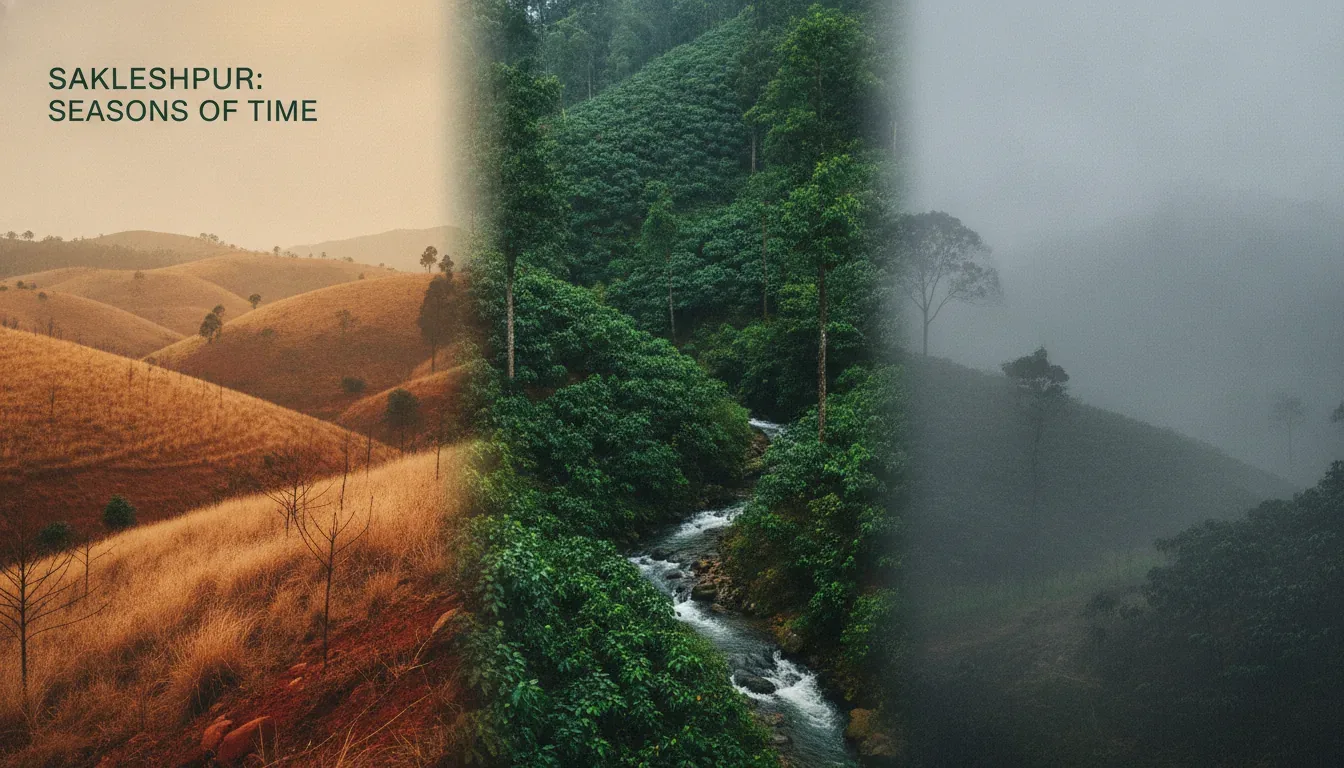
The table shows Sakleshpur weather month by month: Sakleshpur temperature by day and night, Sakleshpur rain, and what each month is good for.
Month
Day / night °C
Rain (mm)
Waterfalls
Treks
Coffee estates
Crowds
VerdictJan | 28 / 15 | 1 | Low | Good | Harvest | Medium | Cool and clear
Feb | 30 / 16 | 2 | Low | Good | Harvest ends | Low | Quietest month
Mar | 32 / 18 | 6 | Low | Hot midday | Flowering | Medium | Warm, dry days
Apr | 32 / 20 | 73 | Low | Hot midday | Flowering | Medium | First showers
May | 30 / 20 | 117 | Low | Hot midday | Green berries | High | Busy with families
Jun | 26 / 19 | 320 | Rising | Wet, leeches | Green berries | Medium | Monsoon begins
Jul | 24 / 19 | 835 | Full | Wet, leeches | Green berries | Medium | For rain lovers only
Aug | 24 / 19 | 431 | Full | Wet, leeches | Green berries | Medium | Mist and full falls
Sep | 25 / 18 | 144 | Full | Wet, leeches | Green berries | Medium | Green, rain easing
Oct | 27 / 19 | 187 | Flowing | Good | Green berries | High on long weekends | Green, evening showers
Nov | 26 / 17 | 56 | Flowing | Good | Harvest | High on long weekends | The sweet spot
Dec | 26 / 15 | 6 | Low | Good | Harvest | Peak | Cool, dry and busy
Long-term averages. Any single year can be much wetter or drier, and rain varies by place: in 2022, Hethur hobli in Sakleshpura taluk recorded 4,305 mm.
Here is what each season feels like, starting with the coolest months.
What is Sakleshpur like in January and February
January and February are Sakleshpur's coolest and driest months, with nights about 15 to 16°C and almost no rain. January averages about 28°C by day and 1 mm of rain, and February about 30°C and 2 mm.
Views are clear and trails are dry, which makes Sakleshpur in January an easy weekend trip. The coffee harvest winds down as Robusta picking ends in February, and the waterfalls run low. Sakleshpur in February is also the quietest month to book, going by search interest.
At Ashvana, the evenings are cool enough for the bonfire. From March, the heat builds.
What is Sakleshpur like from March to May
March to May brings Sakleshpur's warmest days, about 30 to 32°C, with the first heavy showers arriving in April and May. March is dry at about 6 mm, April holds the heat with about 73 mm of rain, and May cools slightly to about 30°C as pre-monsoon showers bring about 117 mm.
In summer, plan outings for early morning and late afternoon. Coffee blossom follows the first summer showers, usually in March or April. Shettihalli Rosary Church stands clear of the water from December to May, so this is the last window to see it before the rains.
May is busy: school holidays bring families, and resort searches peak that month. After May, the monsoon arrives.
What happens when the monsoon arrives in June
June is when the monsoon sets in: rain jumps to about 320 mm and daytime highs drop to about 26°C, with nights near 19°C. The hills turn green quickly and the waterfalls start to fill.
Trails get wet, and leeches appear wherever the ground stays damp. For a first monsoon trip, June is a gentler choice than the July peak. The wettest weeks come next.
What is Sakleshpur like in July and August
July is Sakleshpur's wettest month, about 835 mm of rain, with August next at about 431 mm. Both months hold about 24°C by day and 19°C at night.
Waterfalls run at their fullest, and mist sits over the hills most days. These are also the riskiest weeks: in each of 2024, 2025 and 2026, landslides in July or August hit the rail line or the Shiradi Ghat road near Sakleshpur.
So is Sakleshpur in July safe? It is fine for a slow stay with short outings, but not for treks. Not everyone enjoys it, either: one YouTube viewer said they would rather have stayed home with pakodas and a movie. If rain is the point of your trip, July and August deliver it. If not, the months after the peak are a better bet.
Why are September to November the sweet spot
September to November combines green hills and flowing falls with far less rain than July. September averages about 144 mm. October gets a little more, about 187 mm, but it comes as short afternoon or evening showers from the northeast monsoon, so mornings are often clear.
November is drier still, about 56 mm, and the Arabica harvest starts. Kanakadasa Jayanti falls on Friday, 11/27/2026, so that long weekend fills early.
Ashvana's 20-acre reserve gives this green season plenty of room to slow down. The busiest month comes next.
What is Sakleshpur like in December
December is cool and dry, with nights about 15°C, and it is the busiest month to book after May, going by search interest. Days reach about 26°C, and rain is about 6 mm for the whole month.
The coffee harvest is in full swing. Christmas falls on Friday, 12/25/2026, which makes a long weekend, so book early or go the week before. With the calendar covered, the monsoon question deserves a closer look.
Is it safe to visit Sakleshpur in the monsoon
A monsoon trip to Sakleshpur is safe if you stay flexible, drive in daylight and skip wet treks. Most trouble comes from landslides on the ghat sections and from slippery trails, and you can plan around both.
Landslides have hit the road or rail near Sakleshpur in each of the last three monsoons:
- 07/16/2024: vehicle restrictions began on the Shiradi Ghat after a landslide at Doddatappale, Sakleshpur taluk, and were lifted once the rains eased.
- 08/16/2025: a landslip near Maranahalli shut the Shiradi Ghat stretch of NH75, and rail landslips hit the Shiribagilu to Donigal section.
- Night of 08/01/2026: a landslide on the rail line between Yedakumari and Shrivagilu cancelled or diverted Bengaluru to Mangaluru trains.
All three were on the Shiradi Ghat road toward Mangaluru or on the rail ghat section. A few simple habits keep a Sakleshpur in monsoon trip on track:
- Leeches are common wherever the trail is wet, from June to October. Wear long socks and closed shoes, and carry salt or leech socks.
- Rocks near waterfalls stay slippery, so keep well back from the edge.
- Keep a spare day in your plan, and check Hassan district rain warnings and road alerts before you set off.
The other thing that can spoil a trip is crowds.
How crowded and expensive do long weekends get
Long weekends are when Sakleshpur is busiest, and stay prices across the area can run two to three times weekday rates. The busiest stretches are May (school holidays), December (Christmas), and the long weekends around Dussehra, Deepavali, Kanakadasa Jayanti and Ugadi.
The next two are Friday, 11/27/2026 (Kanakadasa Jayanti) and Friday, 12/25/2026 (Christmas). Resort search interest peaks in May and December and is lowest in February.
To avoid the crowds and pay weekday rates, go midweek, or leave on a Thursday. Once the dates are set, here is what to bring.
What should you pack for each season
Your Sakleshpur bag depends on the month: a light jacket from November to February, sun protection from March to May, and full rain gear from June to October.
Winter (November to February):
- A light jacket or sweater for nights of about 15°C
- Comfortable walking shoes
Summer (March to May):
- A hat, sunscreen and a water bottle
- An umbrella for the May showers
Monsoon (June to October):
- A rain jacket and quick-dry clothes
- Closed shoes with good grip
- Leech socks or long socks
- A dry bag for phones, and a torch
With the bag sorted, the last choice is where to base yourself.
Where should you stay, whichever month you pick
A stay with space to slow down matters most in the monsoon, when you spend more time indoors, and on long weekends, when town is busy. In the monsoon, look for covered spaces and good food on site. In winter, look for outdoor space to enjoy the dry days.
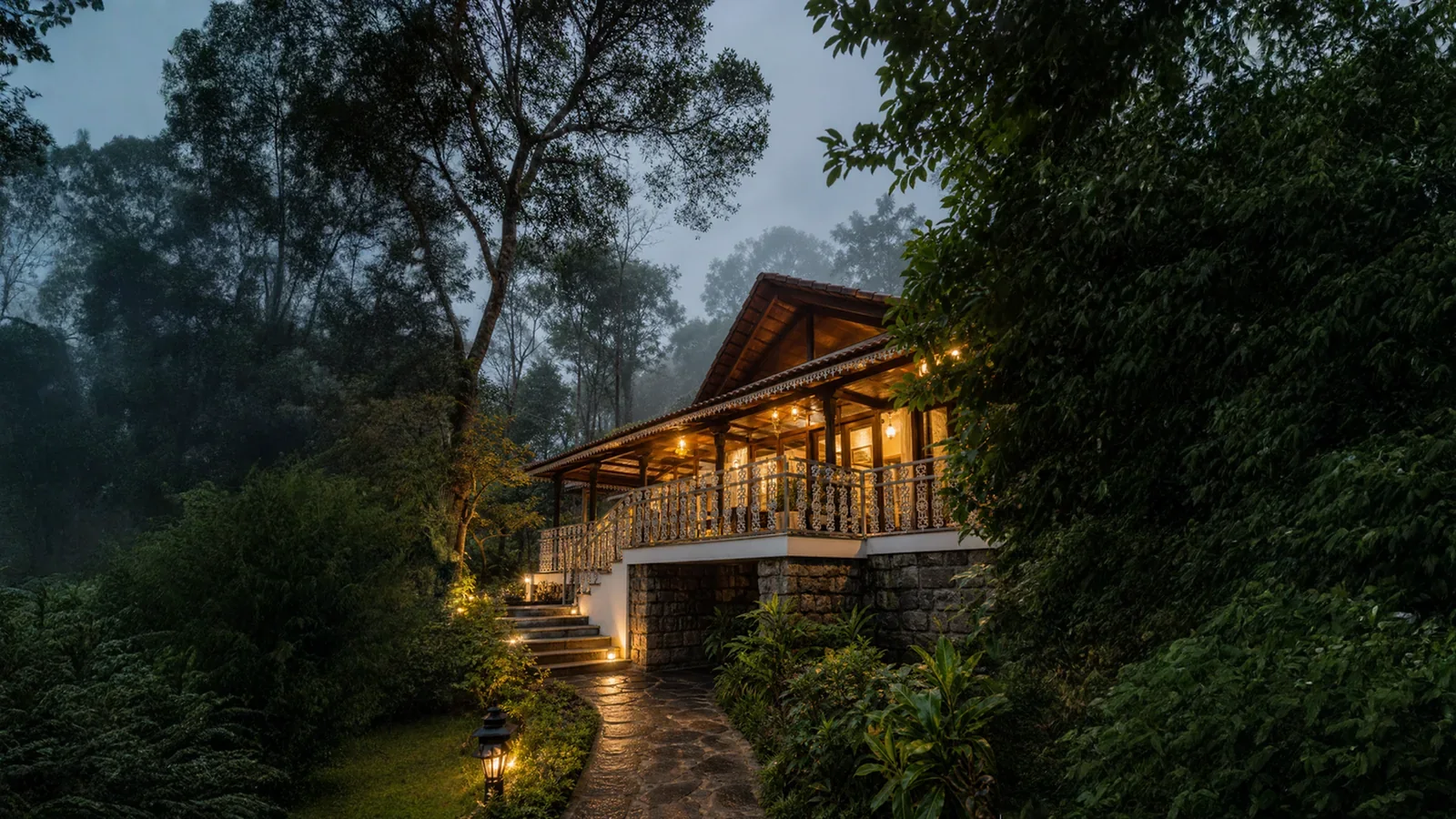
Ashvana is a 20-acre, low-density reserve in Sakleshpur's Malnad hills, with an infinity pool, a spa, coffee walks and a restaurant. Weekday rates start from ₹7,000 for a Twin room. Weekend rates are higher, so weekdays give the better value.
Good to Know
Questions, Answered
Which month is best to visit Sakleshpur?
October to February suits most travellers, with cool nights of about 15 to 19°C, little rain after October and dry trails. Choose July to September only if mist and full waterfalls matter more than clear skies.
What is the worst time to visit Sakleshpur?
Mid-July to mid-August is the hardest time for sightseeing and treks. It brings the heaviest rain of the year and the highest risk of landslide closures.
Does it rain a lot in Sakleshpur?
Yes. Sakleshpur gets about 2,180 mm of rain a year, most of it from June to October, and July alone averages about 835 mm.
Is it good to visit Sakleshpur now?
Check a live forecast and compare it with your month's row in the table above. Between June and October, also check Hassan district rain warnings and road alerts before you leave.
How many days are sufficient for Sakleshpur?
Two days is enough for a relaxed trip that covers the main sights. In the monsoon, add a spare day in case rain changes your plans.
Which is better, Sakleshpur or Coorg?
Sakleshpur is the quieter of the two, and Coorg is busier. If calm matters most, Sakleshpur is the better fit.
What is the best time to visit Sakleshpur from Bangalore?
Go midweek, outside long weekends, and leave early in the morning. The trip takes about 4 to 5 hours by car, so an early start gives you the afternoon at your stay.